Given the root of a binary tree, return the zigzag level order traversal of its nodes' values. (i.e., from left to right, then right to left for the next level and alternate between).
Example 1:
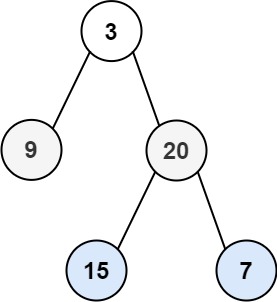
Input: root = [3,9,20,null,null,15,7] Output: [[3],[20,9],[15,7]]
Example 2:
Input: root = [1] Output: [[1]]
Example 3:
Input: root = [] Output: []
Constraints:
[0, 2000].-100 <= Node.val <= 100/**
* Definition for a binary tree node.
* struct TreeNode {
* int val;
* TreeNode *left;
* TreeNode *right;
* TreeNode() : val(0), left(nullptr), right(nullptr) {}
* TreeNode(int x) : val(x), left(nullptr), right(nullptr) {}
* TreeNode(int x, TreeNode *left, TreeNode *right) : val(x), left(left), right(right) {}
* };
*/
class Solution {
public:
vector<vector<int>> zigzagLevelOrder(TreeNode* root) {
vector<vector<int>> ans;
if(root == NULL)
return ans;
queue<TreeNode*> info;
info.push(root);
bool flag = false;
while(!info.empty()){
int n = info.size();
vector<int> inter;
for(; n>0; n--){
TreeNode* top = info.front();
info.pop();
if(top->left != NULL)
info.push(top->left);
if(top->right != NULL)
info.push(top->right);
inter.push_back(top->val);
}
if(flag)
reverse(inter.begin(), inter.end());
ans.push_back(inter);
flag = !flag;
}
return ans;
}
};