Given the head of a singly linked list where elements are sorted in ascending order, convert it to a height-balanced binary search tree.
Example 1:
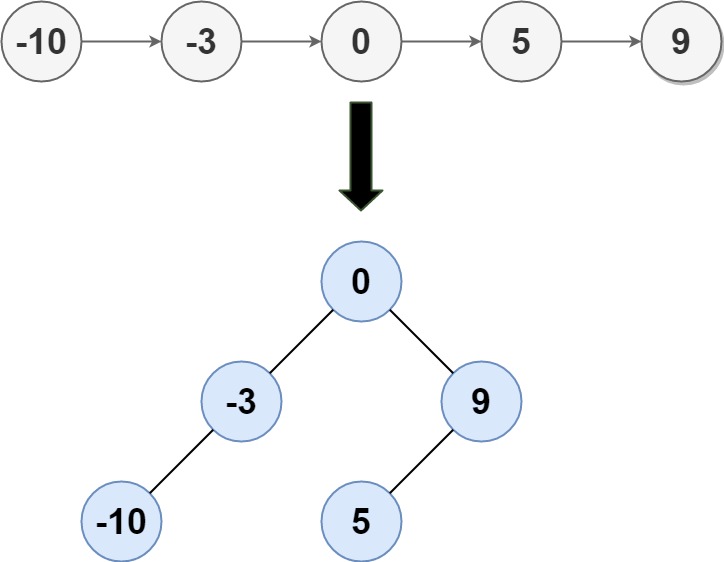
Input: head = [-10,-3,0,5,9] Output: [0,-3,9,-10,null,5] Explanation: One possible answer is [0,-3,9,-10,null,5], which represents the shown height balanced BST.
Example 2:
Input: head = [] Output: []
Constraints:
head is in the range [0, 2 * 104].-105 <= Node.val <= 105/**
* Definition for singly-linked list.
* struct ListNode {
* int val;
* ListNode *next;
* ListNode() : val(0), next(nullptr) {}
* ListNode(int x) : val(x), next(nullptr) {}
* ListNode(int x, ListNode *next) : val(x), next(next) {}
* };
*/
/**
* Definition for a binary tree node.
* struct TreeNode {
* int val;
* TreeNode *left;
* TreeNode *right;
* TreeNode() : val(0), left(nullptr), right(nullptr) {}
* TreeNode(int x) : val(x), left(nullptr), right(nullptr) {}
* TreeNode(int x, TreeNode *left, TreeNode *right) : val(x), left(left), right(right) {}
* };
*/
class Solution {
public:
TreeNode *sortedListToBST(ListNode *head)
{
return sortedListToBST( head, NULL );
}
private:
TreeNode *sortedListToBST(ListNode *head, ListNode *tail)
{
if( head == tail )
return NULL;
if( head->next == tail ) //
{
TreeNode *root = new TreeNode( head->val );
return root;
}
ListNode *mid = head, *temp = head;
while( temp != tail && temp->next != tail ) // 寻找中间节点
{
mid = mid->next;
temp = temp->next->next;
}
TreeNode *root = new TreeNode( mid->val );
root->left = sortedListToBST( head, mid );
root->right = sortedListToBST( mid->next, tail );
return root;
}
};