A matrix diagonal is a diagonal line of cells starting from some cell in either the topmost row or leftmost column and going in the bottom-right direction until reaching the matrix's end. For example, the matrix diagonal starting from mat[2][0], where mat is a 6 x 3 matrix, includes cells mat[2][0], mat[3][1], and mat[4][2].
Given an m x n matrix mat of integers, sort each matrix diagonal in ascending order and return the resulting matrix.
Example 1:
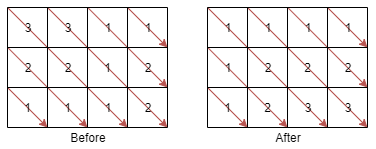
Input: mat = [[3,3,1,1],[2,2,1,2],[1,1,1,2]] Output: [[1,1,1,1],[1,2,2,2],[1,2,3,3]]
Example 2:
Input: mat = [[11,25,66,1,69,7],[23,55,17,45,15,52],[75,31,36,44,58,8],[22,27,33,25,68,4],[84,28,14,11,5,50]] Output: [[5,17,4,1,52,7],[11,11,25,45,8,69],[14,23,25,44,58,15],[22,27,31,36,50,66],[84,28,75,33,55,68]]
Constraints:
m == mat.lengthn == mat[i].length1 <= m, n <= 1001 <= mat[i][j] <= 100class Solution {
public:
vector<vector<int>> diagonalSort(vector<vector<int>>& mat) {
unordered_map<int, priority_queue<int, vector<int>, greater<int>>> m;
// store all vals in priority queue (no need to sort since PQ does that)
// note that all diagonal elements have equal value of `i-j`, we use that as a defining criteria for classification when stored.
for(int i=0; i<mat.size(); i++){
for (int j=0; j<mat[0].size(); j++){
m[i-j].push(mat[i][j]);
}
}
// Replace the values back into original matrix in sorted order
for(int i=0; i<mat.size(); i++){
for (int j=0; j<mat[0].size(); j++){
mat[i][j] = m[i-j].top(); // top elem of PQ (ie, min-heap)
m[i-j].pop(); // pop top elem... cuz its got its correct place in matrix
}
}
return mat;
}
};class Solution {
public:
vector<vector<int>> diagonalSort(vector<vector<int>>& mat) {
vector <int> v;
for(int row=0;row<mat.size(); row++){
for (int i=row, j=0; j<mat[0].size() && i<mat.size(); i++, j++){
v.push_back(mat[i][j]);
}
sort(v.begin(), v.end());
for (int i=row, j=0, c=0; j<mat[0].size() && i<mat.size(); i++, j++){
mat[i][j] = v[c++];
}
v.clear();
}
for(int col=0;col<mat[0].size(); col++){
vector <int> v;
for (int i=0, j=col; j<mat[0].size() && i<mat.size(); i++, j++){
v.push_back(mat[i][j]);
}
sort(v.begin(), v.end());
for (int i=0, j=col, c=0; j<mat[0].size() && i<mat.size(); i++, j++){
mat[i][j] = v[c++];
}
v.clear();
}
return mat;
}
};