Given the head of a linked list and an integer val, remove all the nodes of the linked list that has Node.val == val, and return the new head.
Example 1:
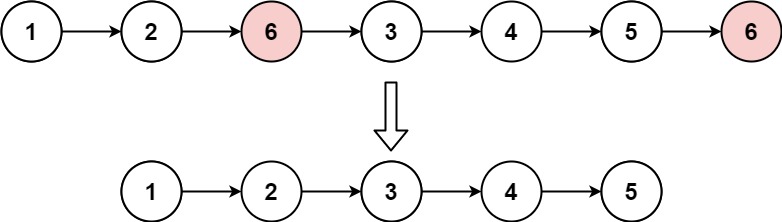
Input: head = [1,2,6,3,4,5,6], val = 6 Output: [1,2,3,4,5]
Example 2:
Input: head = [], val = 1 Output: []
Example 3:
Input: head = [7,7,7,7], val = 7 Output: []
Constraints:
[0, 104].1 <= Node.val <= 500 <= val <= 50/**
* Definition for singly-linked list.
* struct ListNode {
* int val;
* ListNode *next;
* ListNode() : val(0), next(nullptr) {}
* ListNode(int x) : val(x), next(nullptr) {}
* ListNode(int x, ListNode *next) : val(x), next(next) {}
* };
*/
// class Solution {
// public:
// ListNode* removeElements(ListNode* head, int val) {
// ListNode* dummy=new ListNode(0, head); //dummy
// ListNode* curr=head;
// ListNode* prev=dummy;
// while(curr){
// if(curr->val==val)
// prev->next=curr->next;
// else prev=curr;
// curr=curr->next;
// }
// return dummy->next;
// }
// };
class Solution {
public:
ListNode* removeElements(ListNode* head, int val) {
if(!head)
return nullptr;
ListNode* curr=head;
ListNode* prev=head;
while(curr){
if(curr->val==val)
prev->next=curr->next;
else prev=curr;
curr=curr->next;
}
return head->val==val?head->next:head;
}
};