Given the root of a binary search tree, and an integer k, return the kth smallest value (1-indexed) of all the values of the nodes in the tree.
Example 1:
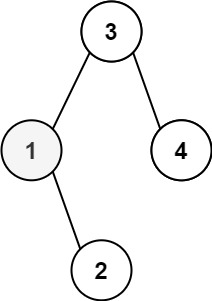
Input: root = [3,1,4,null,2], k = 1 Output: 1
Example 2:
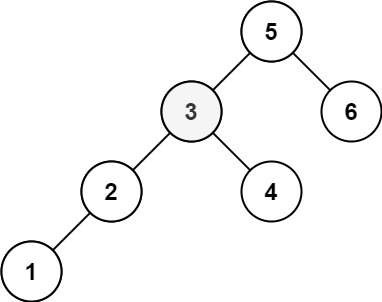
Input: root = [5,3,6,2,4,null,null,1], k = 3 Output: 3
Constraints:
n.1 <= k <= n <= 1040 <= Node.val <= 104
Follow up: If the BST is modified often (i.e., we can do insert and delete operations) and you need to find the kth smallest frequently, how would you optimize?
/**
* Definition for a binary tree node.
* struct TreeNode {
* int val;
* TreeNode *left;
* TreeNode *right;
* TreeNode() : val(0), left(nullptr), right(nullptr) {}
* TreeNode(int x) : val(x), left(nullptr), right(nullptr) {}
* TreeNode(int x, TreeNode *left, TreeNode *right) : val(x), left(left), right(right) {}
* };
*/
class Solution {
public:
TreeNode* increasingBST(TreeNode* ptr) {
auto ltToken = ptr;
if (ptr){
// cout << "\n#" << ptr->val;
if (ptr->right){
ptr->right = increasingBST(ptr->right);
}
if (ptr->left){
ltToken = ptr->left;
while(ltToken->left)
ltToken=ltToken->left;
increasingBST(ptr->left);
if (ptr->left->right){
auto s = ptr->left->right;
while (s->right)
s = s->right;
s->right = ptr;
}
else ptr->left->right = ptr;
ptr->left = nullptr;
}
}
return (ltToken ? ltToken : ptr);
}
int kthSmallest(TreeNode* root, int k) {
TreeNode* newRoot = increasingBST(root);
k--;
while(k--){
newRoot= newRoot->right;
cout<< newRoot->val;}
return newRoot->val;
}
};