You are given a positive integer k. You are also given:
rowConditions of size n where rowConditions[i] = [abovei, belowi], andcolConditions of size m where colConditions[i] = [lefti, righti].The two arrays contain integers from 1 to k.
You have to build a k x k matrix that contains each of the numbers from 1 to k exactly once. The remaining cells should have the value 0.
The matrix should also satisfy the following conditions:
abovei should appear in a row that is strictly above the row at which the number belowi appears for all i from 0 to n - 1.lefti should appear in a column that is strictly left of the column at which the number righti appears for all i from 0 to m - 1.Return any matrix that satisfies the conditions. If no answer exists, return an empty matrix.
Example 1:
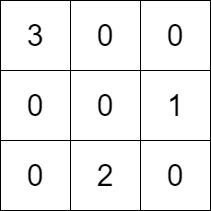
Input: k = 3, rowConditions = [[1,2],[3,2]], colConditions = [[2,1],[3,2]] Output: [[3,0,0],[0,0,1],[0,2,0]] Explanation: The diagram above shows a valid example of a matrix that satisfies all the conditions. The row conditions are the following: - Number 1 is in row 1, and number 2 is in row 2, so 1 is above 2 in the matrix. - Number 3 is in row 0, and number 2 is in row 2, so 3 is above 2 in the matrix. The column conditions are the following: - Number 2 is in column 1, and number 1 is in column 2, so 2 is left of 1 in the matrix. - Number 3 is in column 0, and number 2 is in column 1, so 3 is left of 2 in the matrix. Note that there may be multiple correct answers.
Example 2:
Input: k = 3, rowConditions = [[1,2],[2,3],[3,1],[2,3]], colConditions = [[2,1]] Output: [] Explanation: From the first two conditions, 3 has to be below 1 but the third conditions needs 3 to be above 1 to be satisfied. No matrix can satisfy all the conditions, so we return the empty matrix.
Constraints:
2 <= k <= 4001 <= rowConditions.length, colConditions.length <= 104rowConditions[i].length == colConditions[i].length == 21 <= abovei, belowi, lefti, righti <= kabovei != belowilefti != righticlass Solution {
private void dfs(List<List<Integer>> adj, int[] vis, int V, List<Integer> order, boolean[] hasCycle) {
vis[V] = 1;
for (int nbr : adj.get(V)) {
if (vis[nbr] == 0) {
dfs(adj, vis, nbr, order, hasCycle);
if (hasCycle[0])
return;
} else if (vis[nbr] == 1) { // same node appeared twice in same dfs route
hasCycle[0] = true;
return;
}
}
vis[V] = 2; // Route complete w/o cycles
order.add(V);
}
private List<Integer> topoSort(int[][] edges, int n) {
List<List<Integer>> adj = new ArrayList<>();
for (int i = 0; i <= n; i++)
adj.add(new ArrayList<>());
for (int[] e : edges)
adj.get(e[0]).add(e[1]);
int[] vis = new int[n + 1]; // 0: not visited, 1: visiting in current dfs, 2: visited
boolean[] hasCycle = { false }; // 1 boolean value pass by reference
List<Integer> order = new ArrayList<>();
for (int i = 1; i <= n; i++) {
if (vis[i] == 0) {
dfs(adj, vis, i, order, hasCycle);
if (hasCycle[0])
return new ArrayList<>(); // Not a DAG
}
}
Collections.reverse(order);
return order;
}
public int[][] buildMatrix(int k, int[][] rowConditions, int[][] colConditions) {
int[][] matrix = new int[k][k];
List<Integer> rowOrder = topoSort(rowConditions, k);
List<Integer> colOrder = topoSort(colConditions, k);
if (rowOrder.isEmpty() || colOrder.isEmpty()) // Either !DAG
return new int[0][0]; // matrix generation infeasible
for (int i = 0; i < k; i++)
for (int j = 0; j < k; j++)
if (rowOrder.get(i).equals(colOrder.get(j)))
matrix[i][j] = rowOrder.get(i);
return matrix;
}
}class Solution {
private int[] topoSort(int[][] edges, int n) { // Kahn's algo
List<Integer>[] adj = new ArrayList[n+1];
int[] indegree = new int[n+1], order = new int[n];
for (int i = 0; i <= n; i++)
adj[i] = new ArrayList<>();
for (int[] e : edges){
adj[e[0]].add(e[1]);
indegree[e[1]]++;
}
Queue<Integer> q = new LinkedList<>();
for(int i=1; i<=n; i++)
if(indegree[i]==0)
q.offer(i);
int idx = 0;
while(!q.isEmpty()){
int V = q.poll();
order[idx++] = V;
n--;
for(int nbr: adj[V]){
if(--indegree[nbr]==0)
q.offer(nbr);
}
}
if(n>0) // ain't a DAG
return new int[0];
return order;
}
public int[][] buildMatrix(int k, int[][] rowConditions, int[][] colConditions) {
int[][] matrix = new int[k][k];
int[] rowOrder = topoSort(rowConditions, k);
int[] colOrder = topoSort(colConditions, k);
if (rowOrder.length == 0 || colOrder.length == 0) // Either is !DAG
return new int[0][0]; // matrix generation infeasible
for (int i = 0; i < k; i++)
for (int j = 0; j < k; j++)
if (rowOrder[i]==colOrder[j])
matrix[i][j] = rowOrder[i];
return matrix;
}
}