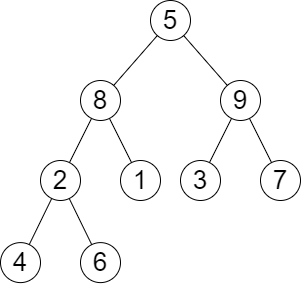
You are given the root of a binary tree with n nodes. Each node is assigned a unique value from 1 to n. You are also given an array queries of size m.
You have to perform m independent queries on the tree where in the ith query you do the following:
queries[i] from the tree. It is guaranteed that queries[i] will not be equal to the value of the root.Return an array answer of size m where answer[i] is the height of the tree after performing the ith query.
Note:
Example 1:
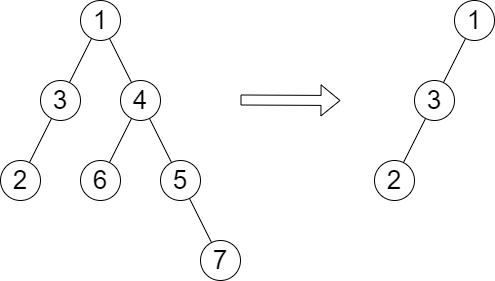
Input: root = [1,3,4,2,null,6,5,null,null,null,null,null,7], queries = [4] Output: [2] Explanation: The diagram above shows the tree after removing the subtree rooted at node with value 4. The height of the tree is 2 (The path 1 -> 3 -> 2).
Example 2:
Input: root = [5,8,9,2,1,3,7,4,6], queries = [3,2,4,8] Output: [3,2,3,2] Explanation: We have the following queries: - Removing the subtree rooted at node with value 3. The height of the tree becomes 3 (The path 5 -> 8 -> 2 -> 4). - Removing the subtree rooted at node with value 2. The height of the tree becomes 2 (The path 5 -> 8 -> 1). - Removing the subtree rooted at node with value 4. The height of the tree becomes 3 (The path 5 -> 8 -> 2 -> 6). - Removing the subtree rooted at node with value 8. The height of the tree becomes 2 (The path 5 -> 9 -> 3).
Constraints:
n.2 <= n <= 1051 <= Node.val <= nm == queries.length1 <= m <= min(n, 104)1 <= queries[i] <= nqueries[i] != root.val/**
* Definition for a binary tree node.
* public class TreeNode {
* int val;
* TreeNode left;
* TreeNode right;
* TreeNode() {}
* TreeNode(int val) { this.val = val; }
* TreeNode(int val, TreeNode left, TreeNode right) {
* this.val = val;
* this.left = left;
* this.right = right;
* }
* }
*/
class Solution {
int maxHtYet = 0, idx = 0;
public int[] treeQueries(TreeNode root, int[] queries) {
Map<Integer, Integer> htAfterRm = new HashMap<>();
traverseLtToRt(root, htAfterRm, 0);
maxHtYet = 0;
traverseRtToLt(root, htAfterRm, 0);
int[] ans = new int[queries.length];
for (int q : queries)
ans[idx++] = htAfterRm.get(q);
return ans;
}
private void traverseLtToRt(TreeNode root, Map<Integer, Integer> htAfterRm, int depth) {
if (root == null)
return;
htAfterRm.put(root.val, maxHtYet);
maxHtYet = Math.max(maxHtYet, depth);
traverseLtToRt(root.left, htAfterRm, depth + 1);
traverseLtToRt(root.right, htAfterRm, depth + 1);
}
private void traverseRtToLt(TreeNode root, Map<Integer, Integer> htAfterRm, int depth) {
if (root == null)
return;
htAfterRm.put(root.val, Math.max(maxHtYet, htAfterRm.get(root.val)));
maxHtYet = Math.max(maxHtYet, depth);
traverseRtToLt(root.right, htAfterRm, depth + 1);
traverseRtToLt(root.left, htAfterRm, depth + 1);
}
}/**
* Definition for a binary tree node.
* public class TreeNode {
* int val;
* TreeNode left;
* TreeNode right;
* TreeNode() {}
* TreeNode(int val) { this.val = val; }
* TreeNode(int val, TreeNode left, TreeNode right) {
* this.val = val;
* this.left = left;
* this.right = right;
* }
* }
*/
class Solution {
int maxHtYet = 0, idx = 0;
public int[] treeQueries(TreeNode root, int[] queries) {
Map<Integer, Integer> htAfterRm = new HashMap<>();
traverseLtToRt(root, htAfterRm, 0);
maxHtYet = 0;
traverseRtToLt(root, htAfterRm, 0);
int[] ans = new int[queries.length];
for (int q : queries)
ans[idx++] = htAfterRm.get(q);
return ans;
}
private void traverseLtToRt(TreeNode root, Map<Integer, Integer> htAfterRm, int depth) {
if (root == null)
return;
maxHtYet = Math.max(maxHtYet, depth);
htAfterRm.put(root.val, maxHtYet);
traverseLtToRt(root.left, htAfterRm, depth + 1);
traverseLtToRt(root.right, htAfterRm, depth + 1);
}
private void traverseRtToLt(TreeNode root, Map<Integer, Integer> htAfterRm, int depth) {
if (root == null)
return;
maxHtYet = Math.max(maxHtYet, depth);
htAfterRm.put(root.val, Math.max(maxHtYet, htAfterRm.get(root.val)));
traverseRtToLt(root.right, htAfterRm, depth + 1);
traverseRtToLt(root.left, htAfterRm, depth + 1);
}
}