Problem Statement
Medium
You are given an integer n. There is an undirected graph with n vertices, numbered from 0 to n - 1. You are given a 2D integer array edges where edges[i] = [ai, bi] denotes that there exists an undirected edge connecting vertices ai and bi.
Return the number of complete connected components of the graph.
A connected component is a subgraph of a graph in which there exists a path between any two vertices, and no vertex of the subgraph shares an edge with a vertex outside of the subgraph.
A connected component is said to be complete if there exists an edge between every pair of its vertices.
Example 1:
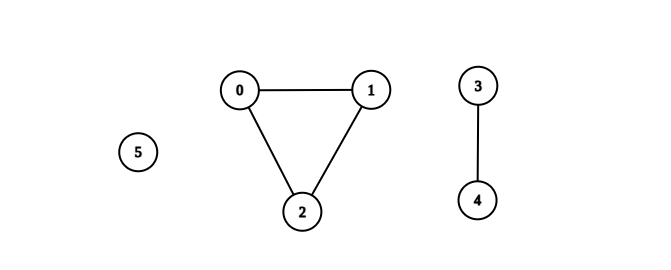
Input: n = 6, edges = [[0,1],[0,2],[1,2],[3,4]]
Output: 3
Explanation: From the picture above, one can see that all of the components of this graph are complete.
Example 2:
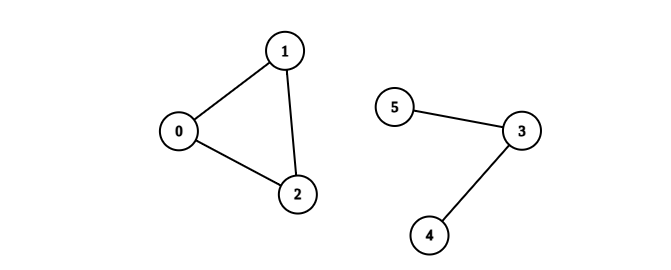
Input: n = 6, edges = [[0,1],[0,2],[1,2],[3,4],[3,5]]
Output: 1
Explanation: The component containing vertices 0, 1, and 2 is complete since there is an edge between every pair of two vertices. On the other hand, the component containing vertices 3, 4, and 5 is not complete since there is no edge between vertices 4 and 5. Thus, the number of complete components in this graph is 1.
Constraints:
1 <= n <= 500 <= edges.length <= n * (n - 1) / 2edges[i].length == 20 <= ai, bi <= n - 1ai != bi- There are no repeated edges.
public class Solution {

    public int countCompleteComponents(int n, int[][] edges) {
        // Initialize Union Find and edge counter
        UnionFind dsu = new UnionFind(n);
        Map<Integer, Integer> edgeCount = new HashMap<>();

        // Connect components using edges
        for (int[] edge : edges) {
            dsu.union(edge[0], edge[1]);
        }

        // Count edges in each component
        for (int[] edge : edges) {
            int root = dsu.find(edge[0]);
            edgeCount.put(root, edgeCount.getOrDefault(root, 0) + 1);
        }

        // Check if each component is complete
        int completeCount = 0;
        for (int vertex = 0; vertex < n; vertex++) {
            if (dsu.find(vertex) == vertex) { // If vertex is root
                int nodeCount = dsu.size[vertex];
                int expectedEdges = (nodeCount * (nodeCount - 1)) / 2;
                if (edgeCount.getOrDefault(vertex, 0) == expectedEdges) {
                    completeCount++;
                }
            }
        }
        return completeCount;
    }

    class UnionFind {

        int[] parent;
        int[] size; // Tracks size of each component

        UnionFind(int n) {
            parent = new int[n];
            size = new int[n];
            Arrays.fill(parent, -1);
            Arrays.fill(size, 1);
        }

        // Find root of component with path compression
        int find(int node) {
            if (parent[node] == -1) {
                return node;
            }
            return parent[node] = find(parent[node]);
        }

        // Union by size
        void union(int node1, int node2) {
            int root1 = find(node1);
            int root2 = find(node2);

            if (root1 == root2) {
                return;
            }

            // Merge smaller component into larger one
            if (size[root1] > size[root2]) {
                parent[root2] = root1;
                size[root1] += size[root2];
            } else {
                parent[root1] = root2;
                size[root2] += size[root1];
            }
        }
    }
}