Problem Statement
3160. Find the Number of Distinct Colors Among the Balls
Medium
You are given an integer limit and a 2D array queries of size n x 2.
There are limit + 1 balls with distinct labels in the range [0, limit]. Initially, all balls are uncolored. For every query in queries that is of the form [x, y], you mark ball x with the color y. After each query, you need to find the number of distinct colors among the balls.
Return an array result of length n, where result[i] denotes the number of distinct colors after ith query.
Note that when answering a query, lack of a color will not be considered as a color.
Example 1:
Input: limit = 4, queries = [[1,4],[2,5],[1,3],[3,4]]
Output: [1,2,2,3]
Explanation:
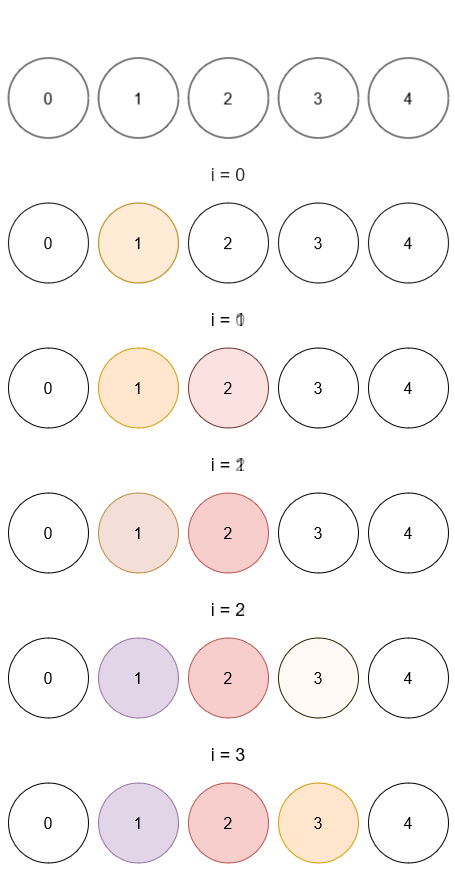
- After query 0, ball 1 has color 4.
- After query 1, ball 1 has color 4, and ball 2 has color 5.
- After query 2, ball 1 has color 3, and ball 2 has color 5.
- After query 3, ball 1 has color 3, ball 2 has color 5, and ball 3 has color 4.
Example 2:
Input: limit = 4, queries = [[0,1],[1,2],[2,2],[3,4],[4,5]]
Output: [1,2,2,3,4]
Explanation:
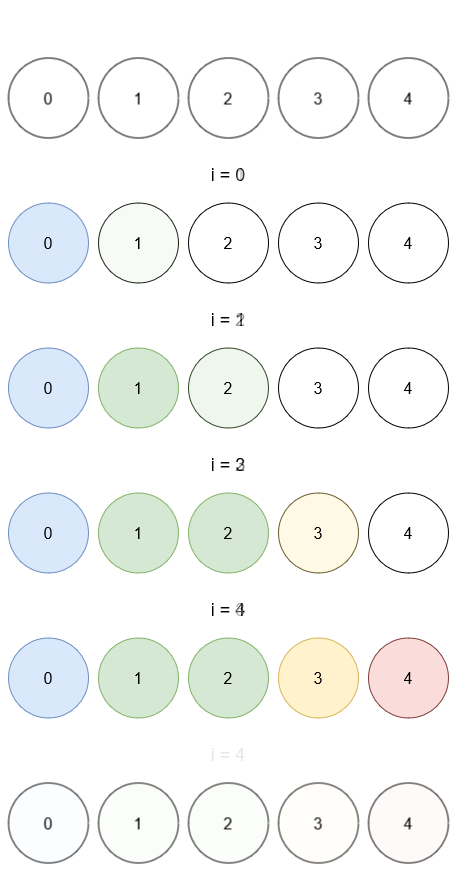
- After query 0, ball 0 has color 1.
- After query 1, ball 0 has color 1, and ball 1 has color 2.
- After query 2, ball 0 has color 1, and balls 1 and 2 have color 2.
- After query 3, ball 0 has color 1, balls 1 and 2 have color 2, and ball 3 has color 4.
- After query 4, ball 0 has color 1, balls 1 and 2 have color 2, ball 3 has color 4, and ball 4 has color 5.
Constraints:
1 <= limit <= 1091 <= n == queries.length <= 105queries[i].length == 20 <= queries[i][0] <= limit1 <= queries[i][1] <= 109