You are given a 2D binary array grid. Find a rectangle with horizontal and vertical sides with the smallest area, such that all the 1's in grid lie inside this rectangle.
Return the minimum possible area of the rectangle.
Example 1:
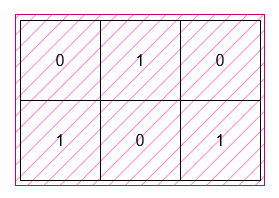
Input: grid = [[0,1,0],[1,0,1]]
Output: 6
Explanation:

The smallest rectangle has a height of 2 and a width of 3, so it has an area of 2 * 3 = 6.
Example 2:
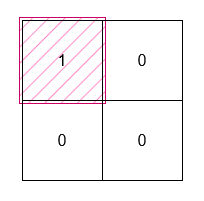
Input: grid = [[1,0],[0,0]]
Output: 1
Explanation:

The smallest rectangle has both height and width 1, so its area is 1 * 1 = 1.
Constraints:
1 <= grid.length, grid[i].length <= 1000grid[i][j] is either 0 or 1.grid.class Solution {
public int minimumArea(int[][] grid) {
int m = grid.length, n = grid[0].length, top = m, btm = -1, lt = n, rt = -1;
for (int i = 0; i < m; i++) {
for (int j = 0; j < n; j++) {
if (grid[i][j] == 1) {
top = Math.min(top, i);
btm = Math.max(btm, i);
lt = Math.min(lt, j);
rt = Math.max(rt, j);
}
}
}
// System.out.println(top + "\t" + btm + "\t" + lt + "\t" + rt);
return (btm - top + 1) * (rt - lt + 1);
}
}class Solution {
public int minimumArea(int[][] grid) {
int m = grid.length, n = grid[0].length, top = m, btm = -1, lt = n, rt = -1;
for (int i = 0; i < m; i++) {
for (int j = 0; j < n; j++) {
if (grid[i][j] == 1) {
top = Math.min(top, i);
btm = Math.max(btm, i);
lt = Math.min(lt, j);
rt = Math.max(rt, j);
}
}
}
// System.out.println(top + "\t" + btm + "\t" + lt + "\t" + rt);
return (btm - top + 1) * (rt - lt + 1);
}
}