Problem Statement
Hard
Given an m x n integers matrix, return the length of the longest increasing path in matrix.
From each cell, you can either move in four directions: left, right, up, or down. You may not move diagonally or move outside the boundary (i.e., wrap-around is not allowed).
Example 1:
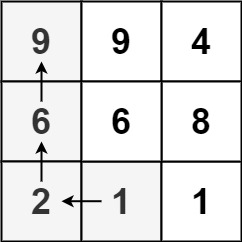
Input: matrix = [[9,9,4],[6,6,8],[2,1,1]]
Output: 4
Explanation: The longest increasing path is [1, 2, 6, 9].
Example 2:
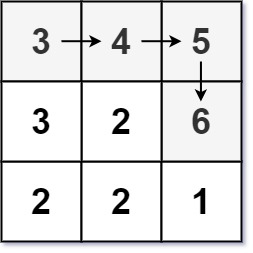
Input: matrix = [[3,4,5],[3,2,6],[2,2,1]]
Output: 4
Explanation: The longest increasing path is [3, 4, 5, 6]. Moving diagonally is not allowed.
Example 3:
Input: matrix = [[1]]
Output: 1
Constraints:
m == matrix.lengthn == matrix[i].length1 <= m, n <= 2000 <= matrix[i][j] <= 231 - 1
class Solution {
    private static int[][] dirs = new int[][] { { 0, -1 }, { 0, 1 }, { -1, 0 }, { 1, 0 } };
    private int m, n;

    public int longestIncreasingPath(int[][] matrix) {
        m = matrix.length;
        n = matrix[0].length;
        int[][] dp = new int[m][n];
        int maxLen = 1;
        for (int i = 0; i < m; i++)
            for (int j = 0; j < n; j++) {
                dp[i][j] = move(matrix, dp, i, j);
                maxLen = Math.max(maxLen, dp[i][j]);
            }
        return maxLen;
    }

    private int move(int[][] matrix, int[][] dp, int r, int c) {
        if (dp[r][c] != 0)
            return dp[r][c];
        dp[r][c] = 1;
        for (int[] dir: dirs) {
            int newRow = r + dir[0], newCol = c + dir[1];
            if (isValid(newRow, newCol) && matrix[newRow][newCol] > matrix[r][c])
                dp[r][c] = Math.max(dp[r][c], 1 + move(matrix, dp, newRow, newCol));
        }
        return dp[r][c];
    }

    private boolean isValid(int r, int c) {
        if (r < 0 || r >= m || c < 0 || c >= n)
            return false;
        return true;
    }
}