Given an m x n matrix matrix and an integer k, return the max sum of a rectangle in the matrix such that its sum is no larger than k.
It is guaranteed that there will be a rectangle with a sum no larger than k.
Example 1:
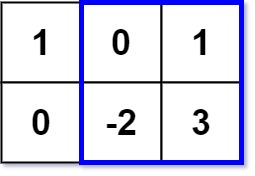
Input: matrix = [[1,0,1],[0,-2,3]], k = 2 Output: 2 Explanation: Because the sum of the blue rectangle [[0, 1], [-2, 3]] is 2, and 2 is the max number no larger than k (k = 2).
Example 2:
Input: matrix = [[2,2,-1]], k = 3 Output: 3
Constraints:
m == matrix.lengthn == matrix[i].length1 <= m, n <= 100-100 <= matrix[i][j] <= 100-105 <= k <= 105
Follow up: What if the number of rows is much larger than the number of columns?
class Solution {
public:
// function for finding maximum subarray having sum less than k
int find_max(vector<int>& arr, int k)
{
int n = arr.size();
int maxi = INT_MIN;
// curr_sum will store cumulative sum
int curr_sum = 0;
// set will store the prefix sum of array
set<int> s;
// put 0 into set, if curr_sum == k, (curr_sum - k) will be zero
s.insert(0);
for(int i = 0; i < n; i++)
{
// calculate cumulative sum
curr_sum += arr[i];
// find the prefix sum in set having sum == curr_sum - k
auto it = s.lower_bound(curr_sum - k);
// if prefix sum is present, update the maxi
if(it != s.end())
{
maxi = max(maxi, curr_sum - *it);
}
// insert prefix sum into set
s.insert(curr_sum);
}
return maxi;
}
int maxSumSubmatrix(vector<vector<int>>& matrix, int k) {
int n = matrix.size();
int m = matrix[0].size();
int maxi = INT_MIN;
// fix the position of two rows and take cumulative sum of columns between two fixed rows
for(int start_row = 0; start_row < n; start_row++)
{
vector<int> col_array(m, 0);
for(int end_row = start_row; end_row < n; end_row++)
{
// take cumulative sum of columns between two fixed rows
for(int col = 0; col < m; col++)
{
col_array[col] += matrix[end_row][col];
}
// find maximum subarray having sum less than equal to k
int curr_max = find_max(col_array, k);
// update the maximum sum
maxi = max(maxi, curr_max);
}
}
return maxi;
}
};