← All problems

684. Redundant Connection

MediumOpen on LeetCodeProblem statement

Problem Statement

684. Redundant Connection

Medium


In this problem, a tree is an undirected graph that is connected and has no cycles.

You are given a graph that started as a tree with n nodes labeled from 1 to n, with one additional edge added. The added edge has two different vertices chosen from 1 to n, and was not an edge that already existed. The graph is represented as an array edges of length n where edges[i] = [ai, bi] indicates that there is an edge between nodes ai and bi in the graph.

Return an edge that can be removed so that the resulting graph is a tree of n nodes. If there are multiple answers, return the answer that occurs last in the input.


Example 1:
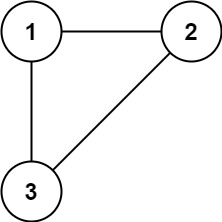
Input: edges = [[1,2],[1,3],[2,3]]
Output: [2,3]

Example 2:
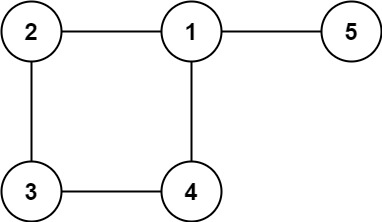
Input: edges = [[1,2],[2,3],[3,4],[1,4],[1,5]]
Output: [1,4]


Constraints:

Java

Source file
class Solution {
    private class UnionFind {
        int[] root;
        int[] rank;

        UnionFind(int n) {
            root = new int[n];
            rank = new int[n];
            for (int i = 0; i < n; i++) {
                root[i] = i;
                rank[i] = 1;
            }
        }

        int find(int x) {
            if (x == root[x])
                return x;
            return root[x] = find(root[x]);
        }

        void union(int x, int y) {
            int rootX = find(x);
            int rootY = find(y);
            if (rootX != rootY) {
                if (rank[rootX] > rank[rootY])
                    root[rootY] = rootX;
                else if (rank[rootY] > rank[rootX])
                    root[rootX] = rootY;
                else {
                    root[rootX] = rootY;
                    rank[rootY]++;
                }
            }
        }

        boolean connected(int x, int y) {
            return find(x) == find(y);
        }
    }

    public int[] findRedundantConnection(int[][] edges) {
        int n = edges.length;
        UnionFind uf = new UnionFind(n + 1);
        for (int[] e : edges)
            if (uf.connected(e[0], e[1]))
                return e;
            else
                uf.union(e[0], e[1]);
        return new int[2];
    }
}