Problem Statement
Medium
A 3 x 3 magic square is a 3 x 3 grid filled with distinct numbers from 1 to 9 such that each row, column, and both diagonals all have the same sum.
Given a row x col grid of integers, how many 3 x 3 contiguous magic square subgrids are there?
Note: while a magic square can only contain numbers from 1 to 9, grid may contain numbers up to 15.
Example 1:
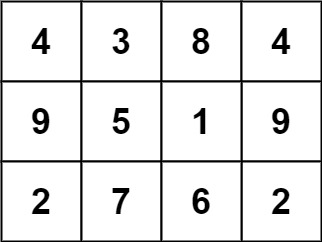
Input: grid = [[4,3,8,4],[9,5,1,9],[2,7,6,2]]
Output: 1
Explanation:
The following subgrid is a 3 x 3 magic square:
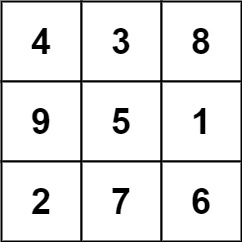 while this one is not:
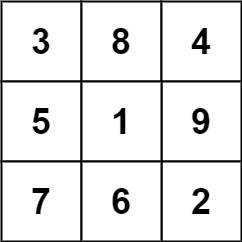 In total, there is only one magic square inside the given grid.
Example 2:
Input: grid = [[8]]
Output: 0
Constraints:
row == grid.lengthcol == grid[i].length1 <= row, col <= 100 <= grid[i][j] <= 15
class Solution {
    public int numMagicSquaresInside(int[][] grid) {
        int m = grid.length, n = grid[0].length, ans = 0;
        for (int i = 0; i < m - 2; i++)
            for (int j = 0; j < n - 2; j++)
                if (isMagicSq(grid, i, j))
                    ans++;
        return ans;
    }

    private boolean isMagicSq(int[][] grid, int rowStart, int colStart) {
        int[] rowSum = new int[3];
        int[] colSum = new int[3];
        int[] diagSum = new int[2];
        for (int i = 0; i < 3; i++) {
            for (int j = 0; j < 3; j++) {
                int cell = grid[rowStart + i][colStart + j];
                if (cell == 0 || cell > 9)
                    return false;
                rowSum[i] += cell;
                colSum[i] += grid[rowStart + j][colStart + i];
            }
            diagSum[0] += grid[rowStart + i][colStart + i];
            diagSum[1] += grid[rowStart + i][colStart + 2 - i];
        }
        // System.out.println(Arrays.toString(rowSum));
        // System.out.println(Arrays.toString(colSum));
        // System.out.println(Arrays.toString(diagSum));
        int match = diagSum[0];
        for (int i = 0; i < 3; i++)
            if (rowSum[i] != match || colSum[i] != match)
                return false;
        return match == diagSum[1];
    }
}